
Materials discovery · 2025
Liquid-state high-entropy catalysts
Configuring a Liquid State High‐Entropy Metal Alloy Electrocatalyst
A liquid alloy catalyst combines multiple elements and mobile active sites to improve nitrate-to-ammonia electrosynthesis. Molecular dynamics, experimental design and density functional theory connect alloy composition with cooperative reaction pathways.
Abstract
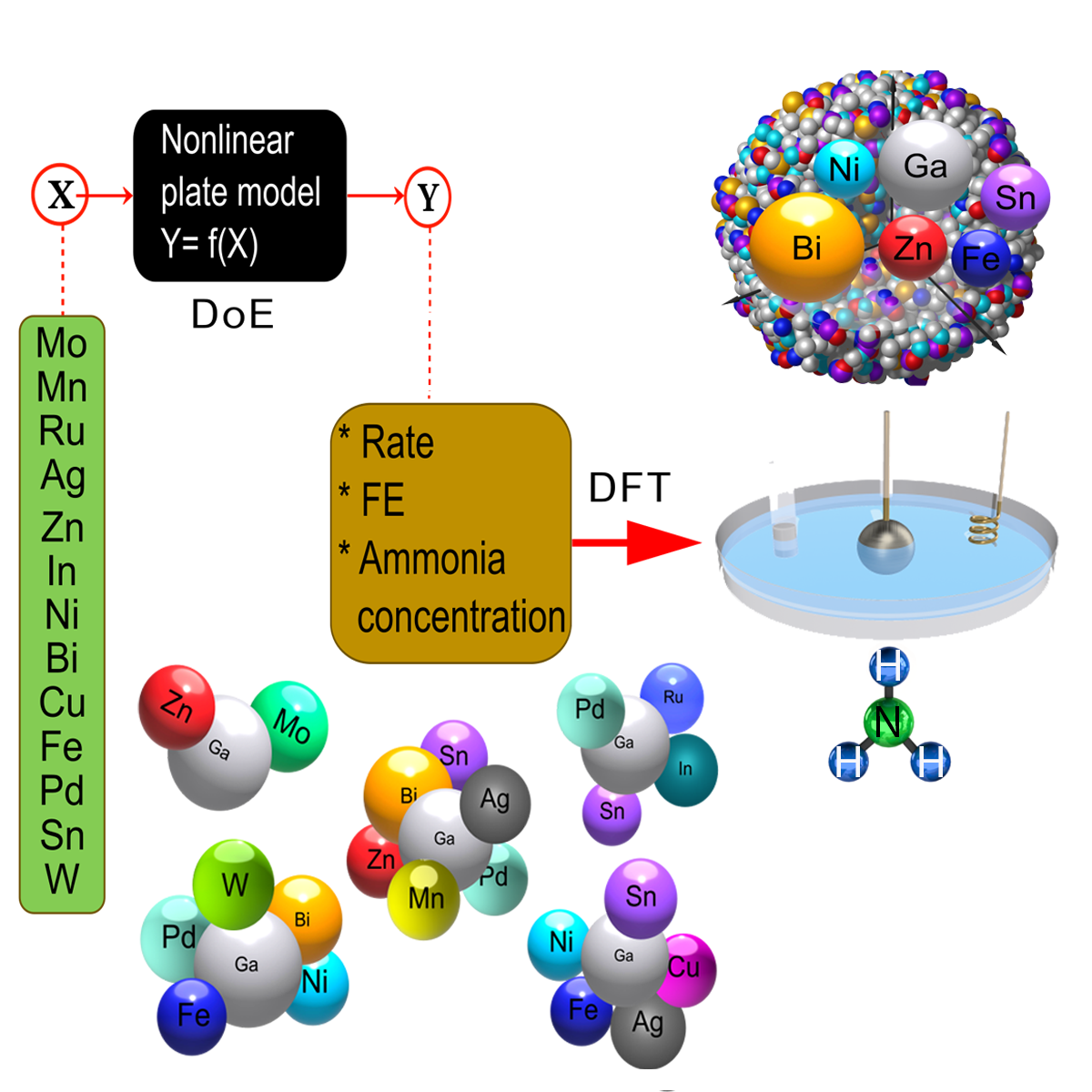
A high‐entropy liquid metal alloy (Ga–Fe–Zn–Sn–Bi–Ni) is developed to address the multi‐step complexity of green ammonia electrosynthesis from nitrate. Guided by molecular dynamics, design of experiments, and density functional theory, this alloy exploits high configurational entropy to form diverse, atomically dispersed active sites. The liquid state eliminates endothermic barriers by enabling nitrogen intermediates to move freely to the most energetically favorable sites. Crucially, a hydrogen shuttling mechanism is uncovered where Fe acts as a proton hub while Sn, Ni, and Zn store and transfer hydrogen to Fe, enhancing reaction kinetics and preventing catalyst saturation. This synergy boosts ammonia production rates up to sevenfold while maintaining high Faradaic efficiency (FE). By integrating entropy‐driven design, dynamic site reconfiguration, and hydrogen management, this work establishes a robust foundation for efficient, scalable ammonia electrosynthesis in pursuit of NetZero targets.
Citation
Sahar Nazari; Ali Najmi; Priyank Kumar; Ali Zavabeti; Francois‐Marie Allioux; Anirudh Raju Natarajan; Dorna Esrafilzadeh; Ali R. Jalili. Configuring a Liquid State High‐Entropy Metal Alloy Electrocatalyst. Small 21(32), 2504087 (2025).
Open access · CC BY 4.0. Published version; article content unchanged.
Download BibTeXDr Ali R. Jalili · UNSW Sydney
ORCID 0000-0003-3851-0818